
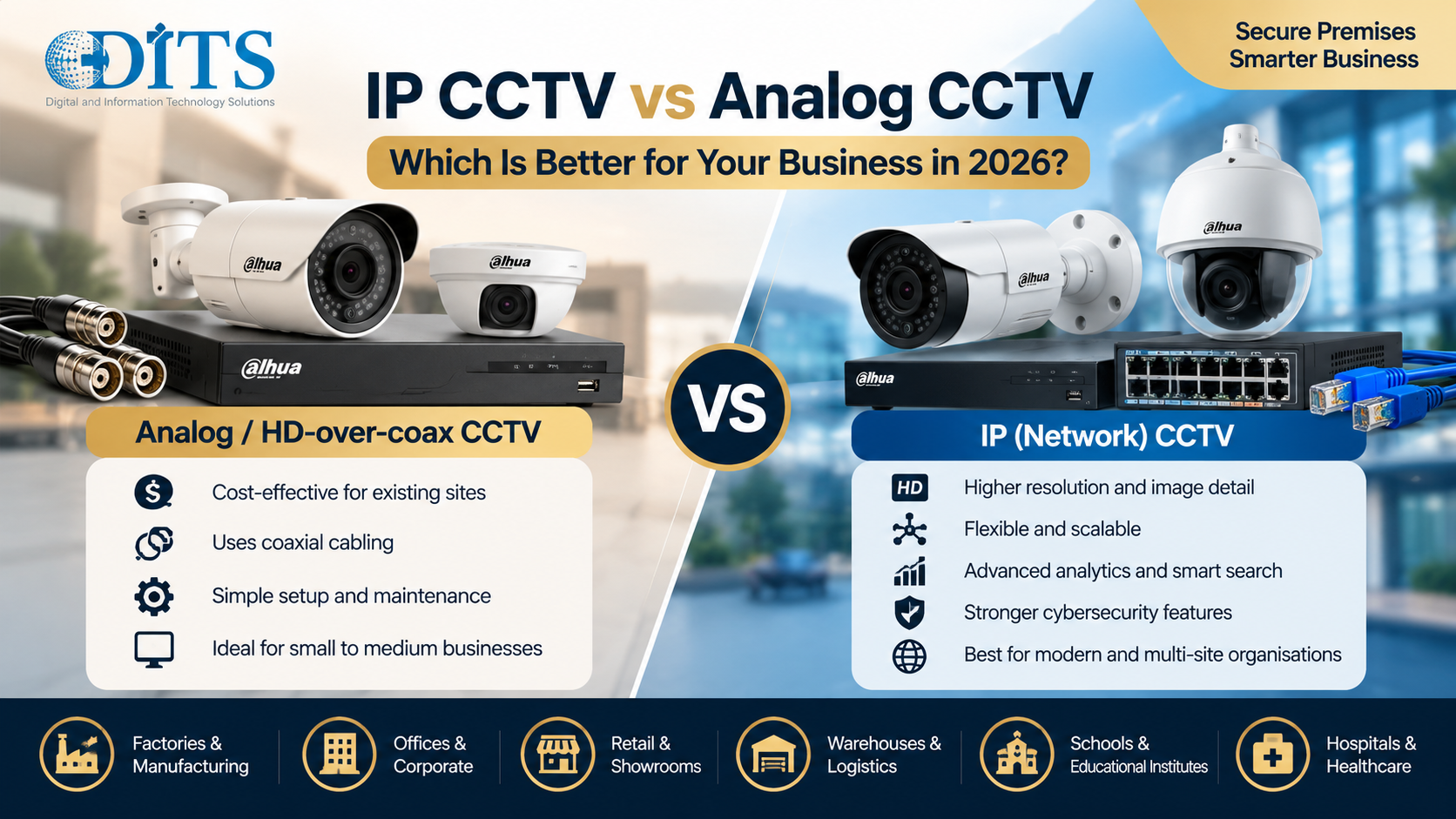
Most organizations in Pakistan now treat video surveillance as operational infrastructure rather than a standalone security purchase. Footage is used to investigate incidents, verify deliveries, monitor production areas, support insurance claims and supervise remote branches. That shift changes the buying question. It is no longer only "how many cameras do we need?" but "which architecture will still serve us in five to seven years?"
The two main options are IP (network) CCTV and analog CCTV, which today usually means HD-over-coax rather than the low-resolution systems of the past. Both have a legitimate place. This article explains how they differ and how to decide.
How the Two Architectures Work
Analog and HD-over-coax CCTV
A traditional analog camera sends a video signal over coaxial cable to a DVR (digital video recorder), which digitises, compresses and stores it. Early analog systems offered standard-definition images that were often too soft to identify faces or number plates.
Modern HD-over-coax technologies, such as Dahua's HDCVI, transmit high-definition video over the same coaxial cable. Dahua's HDCVI range includes models up to 4K (8MP), and selected HDCVI cameras and recorders support power over coax (PoC), so check the datasheet for each model. Dahua's XVR recorders also accept a mix of HDCVI, other analog formats and a limited number of IP cameras, which is useful for phased upgrades.
IP CCTV
An IP camera is a networked device. It captures and compresses video itself (typically using H.264 or H.265) and sends it over an Ethernet network to an NVR (network video recorder) or a video management system (VMS). Most business IP cameras are powered through the same cable using Power over Ethernet (PoE), defined in the IEEE 802.3 family of standards.
Because each camera is a computer on your network, IP systems open up higher resolutions, on-camera analytics and flexible recording, but they also bring network and cybersecurity responsibilities.
Key Comparison Areas
Resolution and image detail
IP cameras are widely available from 2MP to 8MP (4K) and beyond, including panoramic and multi-sensor models. HD-over-coax has closed much of the gap, with 2MP to 8MP options available. In practice, the difference at equal resolution is often less about the cable and more about the sensor, lens, low-light performance and correct camera placement.
What matters for a business is the purpose of each camera: general observation, recognition of a known person, or identification of an unknown person or vehicle. A well-placed 4MP camera with the correct lens will usually outperform a poorly positioned 8MP camera.
Cabling and network requirements
- Analog/HD-over-coax: point-to-point coax from each camera to the recorder. Coax typically supports longer runs than Ethernet, which is helpful in large yards and warehouses. Upgrading an existing analog site can reuse sound cabling.
- IP: structured Cat6 (or higher) cabling and PoE switches. A copper Ethernet channel is limited to 100 metres; longer distances require fibre, extenders or intermediate switches. You also need to plan switch PoE budgets, uplink capacity and, ideally, a dedicated VLAN for surveillance traffic.
Storage
Storage is often under-estimated. It depends on resolution, frame rate, compression, scene activity and retention period. As a worked example (arithmetic only, not a measured figure):
A camera recording continuously at an average of 4 Mbps generates about 4 × 86,400 ÷ 8 = 43.2 GB per day. For 30 days of retention, that is roughly 1.3 TB per camera. Thirty such cameras would need around 39 TB before allowing for RAID overhead.
H.265 and "smart" codec settings can reduce this substantially, and motion- or event-based recording reduces it further. Both IP and modern HD-analog recorders support H.265, so the real decision is how much retention you need for operational, audit or insurance reasons.
Cybersecurity
Analog cameras are not directly addressable on a network, so the attack surface sits mainly in the DVR. IP cameras are network endpoints, and poorly configured cameras have been a well-known entry point for attackers globally.
For any networked surveillance system (including DVRs and XVRs connected for remote viewing), good practice includes:
- Changing default credentials and using unique, strong passwords
- Applying manufacturer firmware updates on a defined schedule
- Placing cameras and recorders on a separate VLAN with firewall rules
- Disabling unused services (for example UPnP) and limiting remote access to VPN or vendor-secured platforms
- Logging administrator access and reviewing user accounts periodically
This is where surveillance design overlaps with network design and firewall policy. CCTV should be integrated into the network deliberately, with segmentation and access rules, rather than simply "putting cameras on the LAN".
Analytics and smart search
IP platforms lead in analytics. Dahua's WizSense range uses on-camera deep-learning to classify humans and vehicles, which reduces false alarms caused by moving trees, animals or lighting changes. The WizMind range targets more advanced commercial applications. Some features, such as perimeter protection with human/vehicle filtering, are also available on HD-analog cameras and AI-capable XVRs, but the breadth of analytics is generally wider on IP.
Treat analytics as a tool to improve response, not a replacement for monitoring procedures. Validate each feature in your actual environment before relying on it.
Remote access and multi-site management
Both architectures support mobile and desktop viewing. Dahua's DMSS mobile app and DSS video management platform can manage recorders across multiple branches. IP systems scale more naturally into centralised VMS environments where a head office monitors many sites, but bandwidth between sites must be planned, especially if you intend to stream multiple high-resolution feeds over business broadband links.
Scalability and integration
IP systems are easier to expand: add a camera wherever there is a network port and PoE capacity. They also integrate more readily with access control, intercoms, alarm panels and third-party VMS software. Look for ONVIF conformance (Profile S for streaming, Profile T for advanced streaming, Profile G for recording) when interoperability between brands matters.
Analog systems are limited by recorder channel count; expansion beyond that requires a larger or additional recorder.
Some organizations also want to use camera infrastructure for purposes beyond security, such as recording staff attendance at entrances. If that is on your roadmap, raise it at the design stage, because camera placement, lighting, network capacity and privacy controls all need to account for it. This is generally more practical on an IP platform.
Maintenance
Analog systems are simpler to troubleshoot and suit sites without in-house IT staff. IP systems require firmware management, network monitoring and occasional switch or PoE troubleshooting. In both cases, the most common failures are hard disks, power supplies, and cameras exposed to heat, dust or water ingress, so specify appropriately rated housings (IP66/IP67) for outdoor locations.
Comparison Table
| Factor | Analog / HD-over-coax (e.g., HDCVI) | IP CCTV |
|---|---|---|
| Typical resolution | 2MP–8MP (modern HD-analog) | 2MP–8MP+, panoramic, multi-sensor |
| Cabling | Coax, point-to-point; long runs | Cat6/fibre; 100 m copper limit |
| Power | Separate supply or power-over-coax | PoE (IEEE 802.3af/at/bt) |
| Recorder | DVR / XVR | NVR / VMS |
| Analytics | Basic to moderate (AI XVRs) | Broadest range, on-camera AI |
| Cybersecurity exposure | Mainly the recorder | Every camera is a network endpoint |
| Scalability | Limited by recorder channels | High, network-dependent |
| Third-party integration | Limited | Strong (ONVIF, APIs, VMS) |
| Best fit | Upgrading existing coax sites; budget-sensitive sites; long cable runs | New builds; multi-site; analytics-led projects |
Total Cost of Ownership
Comparing camera prices alone is misleading. A fair TCO assessment over five to seven years should include:
- Cameras and recorders
- Cabling and installation, including civil work, conduit and labour
- Network equipment (PoE switches, fibre links) for IP
- Storage, sized to the real retention requirement
- Power protection (UPS for recorders and PoE switches)
- Software and licences for VMS or analytics, if applicable
- Maintenance, including disk replacement and firmware management
- Cost of upgrade later, if the chosen system cannot meet future needs
For sites that already have healthy coax cabling, an HD-analog upgrade often has a lower initial cost. For new buildings, multi-site organisations or projects requiring analytics and integration, IP usually offers better long-term value.
The hybrid route
A hybrid XVR lets you retain working analog cameras while adding IP cameras where analytics or higher detail is needed. This spreads investment over time and avoids discarding usable equipment.
Buying Checklist
- Define the purpose of each camera: observation, recognition or identification
- Survey existing cabling and test whether coax can be reused
- Decide retention period based on operational, audit and insurance needs
- Calculate storage using realistic bitrates and H.265 settings
- Confirm PoE budget and switch capacity for IP designs
- Plan a separate VLAN and secure remote-access method
- Specify outdoor cameras with suitable IP and IK ratings
- Check ONVIF conformance if mixing brands or using third-party VMS
- Include UPS protection for recorders and network switches
- Agree a maintenance and firmware update schedule with your installer
Frequently Asked Questions
1. Is analog CCTV obsolete in 2026? No. HD-over-coax technologies such as Dahua HDCVI remain a practical option, particularly when upgrading sites with existing coax cabling. They are less suited to analytics-heavy or highly integrated projects.
2. Can I use my existing analog cameras with new IP cameras? Yes, with a hybrid recorder (XVR) that supports both analog and IP inputs. Check the recorder's IP channel limit before planning expansion.
3. How long should we keep CCTV recordings? There is no single answer. It depends on your industry, internal policies, insurance terms and any regulatory requirements. Many businesses choose a period long enough to investigate incidents that are reported late.
4. Are IP cameras safe from hacking? No device is completely safe, but risk is significantly reduced by changing default passwords, updating firmware, segmenting the network and restricting remote access.
5. Do IP cameras need internet access? Not for local recording. Internet connectivity is only needed for remote viewing, cloud services or vendor updates, and it should be configured securely.
Conclusion
Neither technology is universally better. HD-over-coax remains a sensible, cost-conscious choice for upgrading established sites, while IP CCTV is generally the stronger platform for new buildings, multi-branch organisations and projects that rely on analytics, integration and central management. The right decision comes from a site survey, a realistic storage and network plan, and a clear view of how footage will actually be used.
DITS (PVT) LTD provides CCTV Surveillance Systems for businesses across Pakistan. Our surveillance projects draw on related DITS services, including Enterprise Networking, Structured Cabling Solutions, Cybersecurity & Firewall Solutions and UPS & Power Solutions, delivered by a technical team holding Cisco CCIE, Fortinet and Sophos certifications. To discuss your site requirements or arrange a survey, contact our team through www.dits.pk.